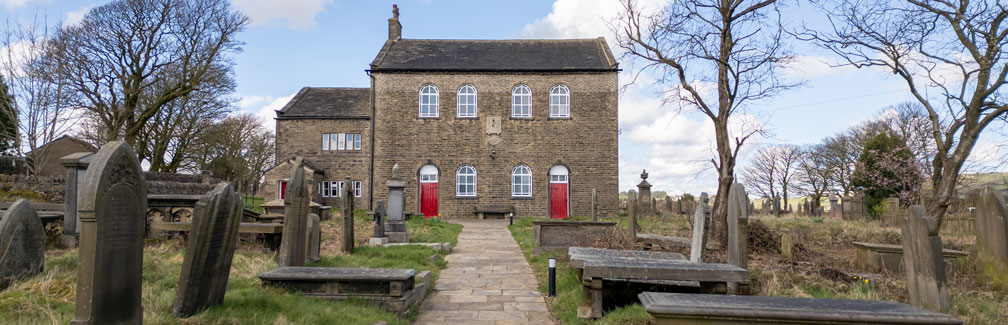
On
the edge of Ogden Moor stands this historic chapel. John Wesley came
to Halifax to preach on the 22nd August 1748 and in the crowd was a man
from Bradshaw, near Halifax, named James Riley. Riley said 'Wesley
disturbed my conscience and troubled my soul.' The following Sunday
Riley went to Haworth to hear the Rev William Grimshaw. All this
resulted in a house meeting being formed. Visitors to that were
people like John Nelson of Birstall. Nelson had returned north
in 1741 after hearing Wesley preach. The idea of building a meeting
place for the Methodists dates back to 1772 when, during a snowstorm,
the visiting preacher was stranded for a week at a house of one
of the members of the Methodist society.
The Chapel
and adjoining cottage was opened in 1773 and was known as Mount Zion,
Bradshaw, it being in the Anglican Parish of Bradshaw. Wesley
came to visit and stayed in the cottage on the 22nd of April 1774.
He records in his journal, 'I rode to Bradshaw House, standing
alone in a dreary waste. But, although it was a cold and
stormy day, the people flocked from all quarters.' The house
afforded hospitality and shelter for man and beast.
The Rev William
Walker wrote a small book entitled 'As told by the Dial' and in
that he tells of the happenings at Mount Zion as if by the sundial
which was on the original building. In that volume he tells of
diamond shaped windows in the cottage on which were etched, initials,
texts etc. one of which said 'Time how short - eternity how long.
C.W.' Was that an indication of CharlesWesley also having visited?
In May, 1790 John
Wesley paid his last visit to Halifax and preached at Mount Zion.
He was then a frail 87 years old and we are told that two friends
assisted him and his memory failed.
After Wesley died
there was growing dissent in his Church and this led to the breaking
away by some people. In 1797 a small group left the Wesleyans
and became New Connexion under the leadership of Alexander Kilham.
At Mount Zion the Kilhamites were very strong and they ousted
the Wesleyans who went to a barn across the road. Mount
Zion is the oldest Methodist New Connexion society which has constantly
met, followed a year later by Shelley, Huddersfield. In
1841 there was another split at Mount Zion when a small number
of Barkerites left the society.
The 1773 church
was demolished and the present building was put in its place in
1815. The only remains of the 1773 building are the sundial
on the front of the building and the foundation stone from the
first building. An impression of the original can be gained
from the adjoining chapel keeper's cottage which was erected at
the same time as the chapel and in the same architectural style.
There have been
a number of Sunday School buildings and the latest is still there
but in private ownership. The first Sunday School was built
in 1816 and the lower storey was a day school.
The organ in the
present building was built in 1892 by Charles Anneessens et fils,
Grommont, Belgique. There are still a few of these organs
in use, probably about six. Most of it is in working order.
The original blower can be seen but it now has an electric blower.
The son of the maker visited during World War 1 and the grandson
in July 1969.
The interior of
the Chapel was done by Leeming and Leeming in 1881 and that firm
became very well known. They did the interior of the Admiralty
Building in London. The pews are pitch pine. There
are 170 ground floor and 180 gallery places. The original
pew rent board is in the vestry.
The building also
houses the Hird Collection of Methodist Ceramics. This was
bequeathed by:-
He was a
well known man in Bradford and one time Lord Mayor. He was
a Primitive Methodist and collected various ceramics which he
displayed in large oak cases in his house. The collection
consists of busts, standing figures, pulpits, Gothic niches, plates,
plaques, teapots, jugs, cups, Lovefeast Cups etc. The collection
is mainly Staffordshire but there are some Wedgwood and Sunderland
pieces. A large part of the collection is displayed permanently
in the Chapel but there is a large reserve collection which is
available for serious collectors and students to see. The
busts consist of John and Charles Wesley, Adam Clark, George Whitfield,
Spurgeon and Sankey and Moody.
There is also
a collection of pictures which are displayed in the cottage during
open days. These depict the life and times of Wesley.
In addition there
is a collection of Mount Zion memorabilia and other pieces which
are of interest locally and these are on display in the Chapel.
The Heritage Centre
is open on the third Saturday of June, July, August and September
from 2.00pm to 4.00pm but can be opened at other times by arrangement.
The cottage is available for away days, small conferences and
meetings. We can cater for coach parties and are willing
to put on afternoon teas. There is a treasure trail for
children. School visits are welcome and we are willing to
go into schools to talk about the Chapel and its history, do Victorian
Sunday School events, and take items of the collection into schools.
The near vicinity
is very good walking territory and we are able to help arrange
walking tours with return to the premises for a meal or advise
on ideas for Sunday School or Other outings. Mount Zion
is on the Calderdale Way.
copyright: Mount
Zion Chapel, Halifax.
Contact Miss Irene
Cunliffe, Heathlands, 24
Old Lees Road,>Hebden Bridge, West Yorkshire HX7 8HW.
Tel: +44 (0) 1422
844364.
email:
Open - For a Sunday service
at 2,45pm throughout the year, Open Days third Saturdays
in June to September 2.00 - 4.00pm, otherwise by arrangement.
Admission -
No charge but donations welcome.
Toilets (not
disabled).
Wheelchair
access to chapel - arrangements for visually handicapped.
Car parking
and coach access.
Thanks
to Irene Cunliffe for the above information.
Page updated
June 25, 2008
Site Monitor,
Anthony Greenwood, will be pleased to receive any comments
regarding the site, or any errors and omissions. Please email me if you tidy
your grave, I will put a new photograph on the website.
Grave database construction,
See Links in left menu, by Clive Lumb, Busset, France.